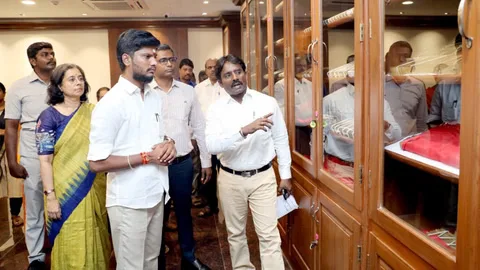
From Srirangam to the Secretariat
S. Ramesh won the seat of the world's largest functioning temple, then was handed the department that runs nearly all of them. Within a week of taking oath he walked into Tiruchendur in a mask to catch a bribe. He is thirty-one.
He won the seat of the largest functioning Hindu temple on earth. Then they put him in charge of nearly all the others.
S. Ramesh is the MLA for Srirangam — the island town in the Cauvery wrapped around the Sri Ranganathaswamy temple, 156 acres of gopurams and gold that draws pilgrims from across the world. On 21 May 2026, six days after the verdict, Chief Minister C. Joseph Vijay handed him the Hindu Religious and Charitable Endowments portfolio: the department that administers some thirty-eight thousand temples across Tamil Nadu, their lands, their treasuries and their priests.
He is thirty-one years old. He had never held public office. And within a week of taking the oath, he walked into one of the state's grandest temples wearing a mask, to catch a bribe in the act.
This is how a priest's son from a 250-square-foot house ended up running the temples.
The seat that fit the man
Start with the symmetry, because it is almost too neat.
Srirangam is not an ordinary constituency. It is a temple town in the literal sense — the Ranganathaswamy complex is the gravitational centre around which the whole island is built. To represent Srirangam is to represent the most temple-defined patch of ground in the state. To then be made the minister for temples is the kind of alignment a screenwriter would cut for being too on-the-nose.
Ramesh won it cleanly. He polled 1,03,235 votes and beat the DMK's S. Durairaj by a margin of 33,590 — a decisive result in a seat the DMK had every reason to defend.
He won the seat of the world's largest functioning temple. Then he was handed the department that runs the rest of them.
For a first-time candidate against an established Dravidian machine, a 33,590-vote cushion is not a squeak-through. It is a mandate. And it gave Vijay a minister whose constituency and whose portfolio told the same story.
The priest's son
The man who now oversees the salaries of temple staff across Tamil Nadu grew up watching his own father earn almost nothing as one.
Ramesh — full name Srinivasan Ramesh, born 1994 — is from Maraimalai Nagar, a satellite town near Chengalpattu. His father, K. Srinivasan, sixty-five, is the priest at the Sri Shiva Vishnu temple there, attached to a small private trust. His salary, after decades of service, is ₹5,000 a month. It began, Srinivasan has said, at ₹300.
The family lives in a roughly 250-square-foot home on the floor of a building beside the temple — accommodation provided free, because the priest's pay could never have covered rent. Ramesh's mother, S. Sumathi, fifty-five, travels close to 90 kilometres each day, to Mylapore in Chennai and back, to work as a cook. Between them, the two incomes were enough to put one of their three sons through an engineering degree. The other two managed diplomas.
That one son was Ramesh. He took a BE from ARM College of Engineering in Maraimalai Nagar, graduating in 2017, and went to work at an automobile company. On the old iron bureau in the family house, there is a faded poster — Vijay's 2012 film Thuppakki. Ramesh has been a fan since he was seventeen, and his father will tell you so plainly: "I have always known my son as a big fan of Vijay."
He is, in other words, exactly the biography TVK was built to elevate. Not a dynast. Not a defector from another party with a network to bring. A young man from a temple's back rooms who followed an actor into politics and never left.
From the fan club to the Assembly
Ramesh's political apprenticeship was the Thalapathy Vijay Makkal Iyakkam — the fan movement that long predated the party. He was not a face on a poster; he was one of the people who built the chains underneath the posters, mobilising youth cadre and running constituency engagement at the ground level for years before Vijay formalised Tamilaga Vettri Kazhagam.
That groundwork is what put him in the room when tickets were decided. In our profiles of the rest of this cabinet — the dentist who walked away from his practice, the IRS officer who quit the service — the same pattern keeps surfacing: TVK rewarded organisers who had done the unglamorous work, not celebrities parachuted in at the end. Ramesh is the purest version of that template. He had no profession to walk away from and no office to lose. He had the movement, and the movement had Srirangam.
A mask, and a temple
Most ministers spend their first month in office on photographs and felicitations. Ramesh spent his on a sting.
On Friday, 29 May 2026 — eight days after taking charge — he arrived at the Tiruchendur Subramaniya Swamy Temple, one of the six sacred abodes of Murugan, dressed as an ordinary devotee. A mask, a casual black T-shirt, no advance notice to local officials. He had been acting on repeated complaints that worshippers were being charged, unofficially, for fast-tracked darshan.
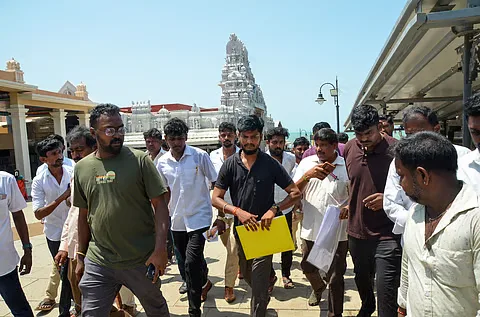
The minister, in the black T-shirt he wore as cover, walking into the Tiruchendur Subramaniya Swamy Temple — the gopuram behind him — to inspect it unannounced.
Inside, a priest approached his aide and named a price: ₹4,000 for four people — ₹1,000 a head — for a quicker passage to the deity. The money was sent by G-Pay, a digital trail with a name on the other end. The priest, Aiyappan, was filmed taking it.
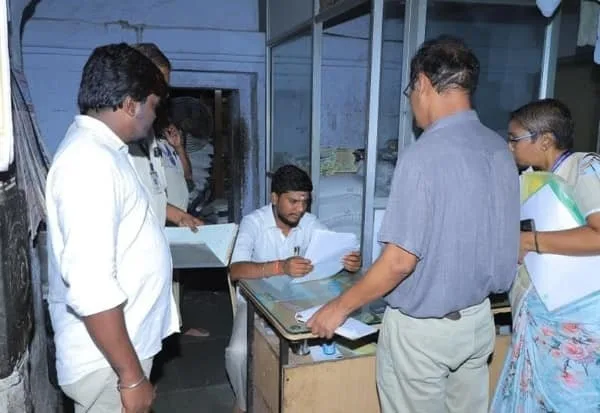
Past the darshan queue, into the back office: the inspection covered annadhanam, temple properties and administrative records, not just the bribe caught on camera.
The action came quickly. Aiyappan was barred from performing poojas; two security personnel and two staff handling the tonsuring facility were relieved of duty pending inquiry. The minister was unsparing and specific in public:
"We have sought explanations, not apologies… action will be taken against anyone found guilty, without any discrimination."
It was an unusual debut. A thirty-one-year-old, a week into office, choosing the most photogenic temple in his portfolio not for a garlanding but for a raid — and broadcasting the result. Whatever else it was, it was a statement about how he intended to read the job: HR&CE as an inspectorate, not a ceremonial department.
The pushback
The reaction told you the politics underneath the theatre.
The next day, 30 May, the DMK's Anitha R. Radhakrishnan — a former minister who represents Tiruchendur — accused Ramesh of insulting the temple's traditional archaka community, priests whose families have served there for generations and who, he argued, receive offerings as a matter of long-standing custom rather than corruption. The charge was that an outsider in a mask had humiliated a hereditary priesthood for a headline.
Ramesh did not retreat. His answer drew the line where a TVK minister would want it drawn:
"People have elected us to take action against those who exploit the public. There is no need to collect money from devotees illegally in the name of service."
It is a genuine fault line, not a manufactured one. The HR&CE minister sits between two constituencies that do not always agree: the devotee who wants a clean, un-extortionate darshan, and the temple establishment whose customs and incomes the state both protects and polices. Ramesh, in his first week, planted himself firmly on the devotee's side of it — and, not incidentally, picked a fight the new government was happy to have.
What it means
There is a temptation to read all of this as a young man's eagerness — the mask, the sting, the quotable lines. That would undersell it.
The HR&CE department is one of the most consequential and most contested in Tamil Nadu. It controls tens of thousands of temples, vast endowment lands, and a politics — over who administers Hindu institutions, and how — that has run hot in the state for a century. To hand it to a thirty-one-year-old first-termer is a real bet. To have that minister be the son of a ₹5,000-a-month priest, representing the state's defining temple town, is the kind of casting TVK clearly understands the value of.
What he does with it past the first headline is the open question. A single undercover raid is a signal, not a system; the test of an HR&CE minister is the unglamorous machinery — appointments, audits, endowment lands, the slow administration of thirty-eight thousand institutions. But the signal he chose to send first was unambiguous, and it rhymed with everything else about him.
He came from a temple's back rooms. He won the temple town. Now he walks into the temples unannounced. For S. Ramesh, the distance from Srirangam to the Secretariat turned out to be very short.